english below
Bereits gegen Ende des 2. Jahrhunderts deklarierte Mark Aurel die Gegenwart als das Einzige, was innerhalb der individuellen Kontrolle liege. Die Vergangenheit ist verblasst und die Zukunft scheint in dunklen Wolken der Ungewissheit zu hängen – lässt sich angesichts dessen noch eine positive Alternative zum Jetzt imaginieren?
Die Ausstellung Das Gegenteil von Jetzt, die als Teil des Programms zum 25-jährigen Bestehen des Jüdischen Museums stattfindet, öffnet Denkräume der Utopie für ihr Publikum. Aufbereitet und inszeniert wurden sie von zwölf Künstler*innen. Ausgangspunkt für die künstlerische Auseinandersetzung ist ein Gespräch zwischen Ernst Bloch und Theodor W. Adorno, das 1964 unter dem Titel Möglichkeiten der Utopie im Radio übertragen wurde. In einem der Ausstellungsräume ist die Unterhaltung nachzuhören. Als so betitelter Denkraum ist er das intellektuelle wie methodische Herz der Ausstellung und liegt auf halbem Wege durch den Rundgang. Spielerisch, tastend, denkend soll hier die eigene Imagination des Publikums angeregt werden.

Der erste Raum der Schau ist dem Chor der Zeitastronauten von Ari Benjamin Meyers gewidmet. In Vitrinen ausgestellt sind persönliche Objekte der Chormitglieder, die alle mindestens 90 Jahre alt sind. Zu bestimmten Zeiten wird sich der Chor hier zu gemeinsamen Proben versammeln, die bewusst nie in einer Aufführung münden – es geht vielmehr um den Versuch, um das immer wieder neue Ansetzen. Die Einleitung hebt die Ausstellung auf eine persönliche Ebene: das individuell-autonome Erproben, sich eine positive Alternative – eine Utopie – des Jetzt vorzustellen. Die Schau möchte, so scheint es, ihr Publikum bei dieser Form der Selbstwirksamkeit unterstützen. Eine gesunde Fähigkeit zur Imagination fächert Möglichkeiten utopischer Potenziale auf, die sich von Mensch zu Mensch weitertragen.
Anders als der Denkraum ist die Ephra-Spur ein vermittelndes Element, das durch die gesamte Ausstellung verläuft. Sie wurde von der Berliner Kunstvermittlungs-Organisation Ephra konzipiert und stellt parallel zu den gezeigten Werken Fragen an die Besucher*innen, denen diese sich beim Wandeln durch die Räume widmen können. Auch in einigen der Kunstwerke schwingt dieser spielerische Charakter mit. So fordert William Forsythes Backwards sein Publikum dazu auf, sich auf eine Bank zu setzen, von ihr wegzuschreiten und den Vorgang dann – mit geschlossenen Augen – rückgängig zu machen. Lässt sich so noch der Weg zurückfinden, oder muss ein ganz neuer geschaffen werden?
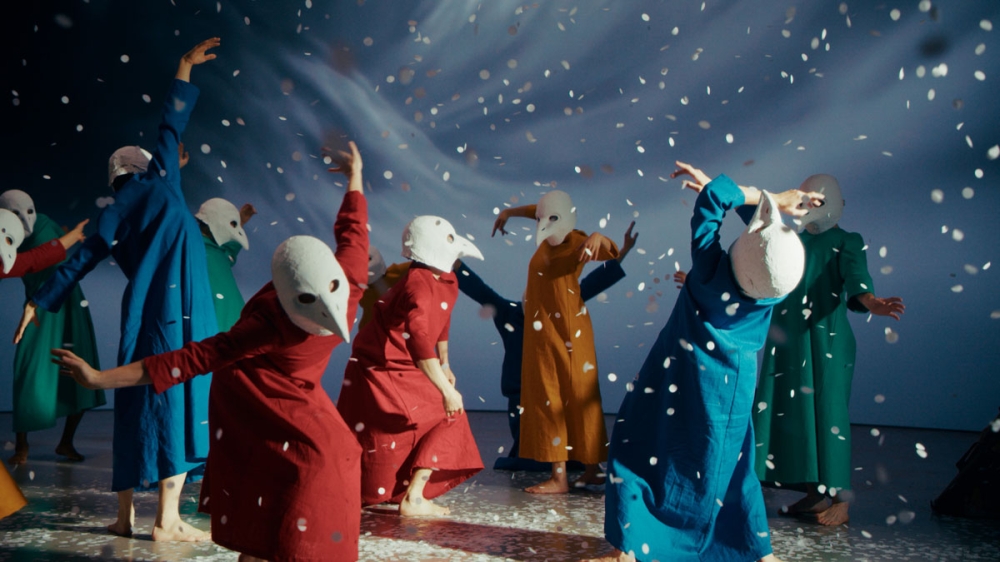
Weitere Arbeiten greifen auf ganz unterschiedliche Weise in dieses Verhältnis von Gegenwart, Vergangenheit und Zukunft ein. Dana Kavelinas Film It Can't Be That Nothing Can Be Returned entwirft eine Zukunft, in der die Toten des Krieges zurückkehren und der Ursprung von Gewalt erforscht werden kann, damit die „Ära des Kummers“ nicht wiederkehrt. Yael Bartanas The Birds setzt dagegen auf den radikalen Ausbruch: Ein Raumschiff soll die Erde verlassen, um und einer neuen Zivilisation Raum zur Entfaltung zu geben und sich jenseits von Krieg und Zerstörung zu formieren. Rettung und Scheitern liegen nah beieinander. Die Hoffnung besteht darin, das Leid zu verstehen und aus diesem Verständnis heraus eine Utopie zu entwerfen.

Alona Rodeh übersetzt in Above and Beyond eine andere Form des Ausbruchs aus bestehenden Zuschreibungen. Mit Umzugskartons baut sie die Kotel (Klagemauer) nach, die im Rhythmus einer elektronisch anmutenden Klangwelt zur Umgebung einer Diskothek werden könnte. Auch die Gruppe Chto Delat International sucht nach Möglichkeiten, Bestehendes umzudeuten. In ihrer Arbeit führt eine Expedition von Hamburg nach Armenien auf die Suche nach rätselhaften Radiosignalen. Das Projekt ist eine von mehreren Arbeiten, die Besucher*innen einbinden. In der Ausstellung wird somit deutlich, dass Utopie weniger als fertiger Entwurf denn als Handlung verstanden wird.
Zum Ende des Rundgangs fordert ein weiteres Werk Forsythes die Besuchenden auf, die Ausstellung mit möglichst unrhythmischem Gang zu verlassen, und schickt sie mit neu- oder vielmehr wiedergefundenen Methoden der Reflexion erneut in die Welt hinaus.
Dennoch hallen nach meinem Besuch die Worte Mark Aurels, die übrigens nicht Teil der Ausstellung sind, sondern eine eigene Randergänzung aus gegebenem Anlass, in mir nach: „Hoffe nicht auf Platos Staat, sondern gib dich zufrieden, wenn es nur den kleinsten Fortschritt gibt [...] Denn wer kann die Prinzipien ändern, nach denen die Menschen ihr Leben regeln?“
Es ist tröstend, dass die individuelle und kollektive Imagination hier trotz der Krisenzeiten intakt bleibt. Die Erkenntnis des Besuchs lautet: Wir haben das Utopisieren nicht verlernt. Doch reicht das als Antwort auf unser Schicksal? Wenn dieser Text veröffentlicht wird, wurde in Sachsen-Anhalt womöglich bereits gewählt. Man muss sich fragen: Hat die Wut der Imagination hier erneut den Weg verstellt?
Yael Bartana, Andrea Büttner, Chto Delat International, Arnold Dreyblatt, William Forsythe, Dana Kavelina, Alexander Kluge, Daniel Laufer, Dor Zlekha Levy, Ari Benjamin Meyers, Alona Rodeh, Eran Schaerf
Das Gegenteil von Jetzt.
Künstlerische Wege in eine andere Gegenwart
4. Sep 2026 bis 10. Jan 2027
Öffnungszeiten:
Di-So 10—18 Uhr
Bitte beachten Sie die kommenden Schließtage an den Hohen Feiertagen: 12.–13. + 21. Sep 2026.
Jüdisches Museum Berlin
Lindenstr. 9–14
10969 Berlin
jmberlin.de/
_______________________________
The Opposite of Now
by Carla Huttenloher
As early as the end of the 2nd century, Marcus Aurelius declared the present to be the only thing within individual control. The past has faded and the future seems to hang in dark clouds of uncertainty—in light of this, is it still possible to imagine a positive alternative to the “now”?
The exhibition “The Opposite of Now”, held as part of the program marking the 25th anniversary of the Jewish Museum, opens conceptual spaces of utopia for its audience. These spaces were prepared and staged by twelve artists. The starting point for this artistic exploration is a conversation between Ernst Bloch and Theodor W. Adorno, broadcast on the radio in 1964 under the title “Possibilities of Utopia”. In one of the exhibition rooms, visitors can listen to the recording of this conversation. Functioning as a designated “thought space” (Denkraum), it serves as both the intellectual and methodological heart of the exhibition, situated halfway through the tour. Here, the audience’s own imagination is meant to be stimulated in a playful, tentative, and contemplative manner.
The first room of the show is dedicated to Ari Benjamin Meyers’ “Choir of Time Astronauts” (Chor der Zeitastronauten). Personal objects belonging to the choir members, all of whom are at least 90 years old, are displayed in vitrines. At specific times, the choir will gather here for rehearsals that deliberately never culminate in a performance—the focus is instead on the attempt, on the repeated process of starting anew. This introduction elevates the exhibition to a personal level: the individual-autonomous endeavor of imagining a positive alternative—a utopia—to the “now.” It seems the exhibition intends to support its audience in this form of self-efficacy. A healthy capacity for imagination unfurls possibilities of utopian potential that are passed on from person to person.
Unlike the Denkraum, the “Ephra Trail” (Ephra-Spur) is a mediating element that runs throughout the entire exhibition. It was conceived by the Berlin art mediation organization Ephra and, parallel to the works on display, poses questions to visitors that they can contemplate while wandering through the rooms. This playful character also resonates in some of the artworks. For instance, William Forsythe’s “Backwards” prompts the audience to sit on a bench, walk away from it, and then—with eyes closed—reverse the process. Can one still find the way back, or must an entirely new one be created?
Other works intervene in this relationship between present, past, and future in very different ways. Dana Kavelina’s film “It Can't Be That Nothing Can Be Returned” envisions a future in which the war dead return and the origins of violence can be investigated so that the “era of sorrow” does not recur. In contrast, Yael Bartana’s “The Birds” focuses on a radical breakout: a spaceship is to leave Earth to provide space for a new civilization to unfold and form itself beyond war and destruction. Salvation and failure are closely intertwined. Hope lies in understanding suffering and, from that understanding, designing a utopia.
In “Above and Beyond”, Alona Rodeh translates another form of breaking out from existing attributions. Using moving boxes, she reconstructs the Kotel (Western Wall), which, to the rhythm of an electronic soundscape, could become the environment of a nightclub. The collective Chto Delat International also seeks ways to re-interpret the existing. In their work, an expedition leads from Hamburg to Armenia in search of enigmatic radio signals. The project is one of several works that involve visitors. Thus, the exhibition makes it clear that utopia is understood less as a finished blueprint and more as an action.
At the end of the tour, another work by Forsythe prompts visitors to leave the exhibition with a gait as unrhythmic as possible, sending them back out into the world with newly—or rather rediscovered—methods of reflection.
Nevertheless, after my visit, the words of Marcus Aurelius echo within me—words that, incidentally, are not part of the exhibition but rather a personal marginal note for the occasion: “Hope not for Plato's Republic, but be content if there is even the smallest progress [...] For who can change the principles by which people regulate their lives?”
It is comforting that individual and collective imagination remains intact here despite these times of crisis. The insight gained from the visit is: we have not unlearned the act of utopianizing. But is this a sufficient response to our fate? By the time this text is published, the elections in Saxony-Anhalt may have already taken place. One must ask: has the rage of the imagination once again obstructed the path here?