english below
Die aktuelle Ausstellung Rauschen: Echos einer Institution in der ifa-Galerie Berlin widmet sich dem "Zentrum für Kunstausstellungen" in der DDR, kurz ZfK. Sie ist das Ergebnis dreijähriger Forschungsarbeit und bildet den Auftakt einer fünfteiligen Ausstellungsreihe.
Das ZfK realisierte seit seiner Gründung 1973 in 15 Jahren rund 2.000 Ausstellungen in der DDR und kooperierte dabei mit über 90 Staaten weltweit. Nach seiner Schließung 1991 ging die dazugehörige Kunstsammlung von rund 10.000 Werken an das heutige ifa.
In der Ausstellung wird die Geschichte des ZfK streng chronologisch erzählt, originale Werke sowie Reproduktionen von Archivmaterial oder auch Ausschnitte von Interviews mit Zeitzeug*innen hängen gleichwertig nebeneinander, ergänzt von Infotexten zu den einzelnen Stationen. Diese Cluster verzahnen die kulturpolitische Rolle des ZfK mit den historischen Ereignissen und den politischen Begebenheiten seiner Zeit.
Das Erscheinungsbild der Ausstellung, die Parallelität der Materialien, spiegelt die Vorstellung von Archivarbeit wider – vom Zettelkasten über die Kartei bis zur Notiz: sie alle machen das vielstimmige Wirken des ZfK, gewissermaßen das Rauschen hinter der offiziellen Berichterstattung, hörbar. Dabei geht es um die aktive Teilnahme auf der documenta 6, die erste Repräsentanz in Venedig 1982 und – wie oben angesprochen – die internationale Zusammenarbeit zwischen Ländern wie Belgien, Syrien oder Indien und Südafrika.

Die Arbeiten der gezeigten zeitgenössischen Künstler*innen greifen das historische Material auf und transformieren die Recherchen in die Gegenwart. Zwischen dem Heute und dem Damals, vermittelt durch die Materialien, Bilder oder Erzählungen, ergibt sich ein Echo, wie ein freundlicher Dialog.
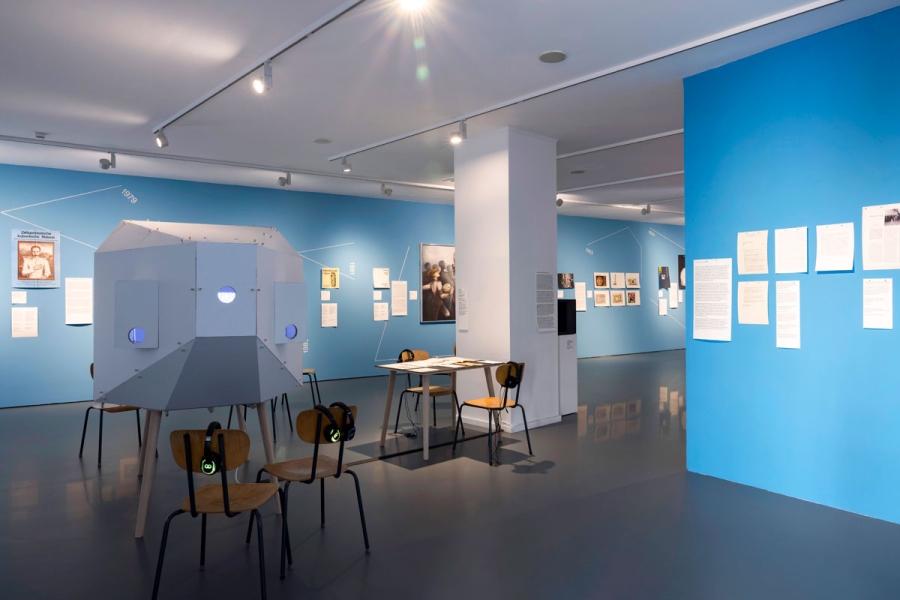
Infolge eines Kulturabkommens zwischen der DDR und Syrien kam es zu Ausstellungen und Kooperationen zwischen den Ländern. Werner Schinkos Werke, die im Rahmen seiner Reisen und seines Austausches nach Syrien entstanden sind, zeugen von Nähe und einem sensiblen Umgang mit den Menschen vor Ort. Angelehnt an ein Setting, das Schinko in Damaskus baute, konstruierte die Künstlerin Anna Bromley einen großen Guckkasten. Durch die Löcher und Fenster der InstallationVagant Orient sind kleinformatige Bilder zu sehen, die das aktive Wirken Schinkos und des ZfK zeigen. Mit dem Maßstabssprung, der teils ungewöhnlichen Sichtachse auf die Objekte, werden Erzählweisen und visuelle Codes hinterfragt. Auch die Künstlerin Suse Weber beschäftigt sich mit der Person Werner Schinko, der zahlreiche Schul- und Kinderbücher der DDR illustrierte. Webers Druckmaschine Bohrer_Bühne: Knüppel aus dem Sack dient dabei einer Überschreibung des Materials, seiner Geschichte und Rekontextualisierung. Ähnlich operieren auch die Künstlerinnen Nadja Abt und Katharina Marszewski mit dem Material. Sie nehmen Robert Rauschenbergs ROCI-Ausstellung" 1990 in Berlin, zu deren Anlass er auch das hier ausgestellte Werk dem ZfK schenkte, zum Anlass einen Kulturdialog über die Jahrzehnte filmisch zu inszenieren.
Im Schaufenster der ifa hängen 6 Poster der Reihe Das Utopographische Plakat von David Polzin. Sie appellieren an eine utopisch-visionäre Zukunft nach 1990, assoziieren einen Möglichkeitsraum, wo beide Staaten koexistieren und voneinander lernen. Angesichts aktueller Wahlumfragen scheint die Koexistenz heute real geworden, doch ohne den positiven Turn des Zusammenhalts, einer gemeinsamen Zukunft.
Künstler*innen: Nadja Abt, Gerhard Altenbourg, Alfred Beier-Red, Henryk Berg, Anna Bromley, Hermann Glöckner, Gotthard Graubner, HAP Grieshaber, Heidrun Hegewald, Irmgard Horlbeck-Kappler, Katharina Mercedes Marszewski, Karl Erich Müller, Uwe Pfeifer, Sigmar Polke, David Polzin, Nuria Quevedo, Robert Rauschenberg, Hans Theo Richter, Werner Schinko, Emil Stumpp, Günther Uecker, Suse Weber, Karla Woisnitza
Rauschen
Echos einer Institution
26. Juni 2026 - 27. Sept. 2026
ifa-Galerie Berlin
Linienstr. 139 - 140
10115 Berlin
www.ifa.de
____________________
Archival Practice as an Art Form: ifa-Galerie Berlin Launches a Five-Part Exhibition Series on the ZfK
von Maximilian Wahlich
The current exhibition “Static: Echoes of an Institution” at ifa Gallery Berlin is dedicated to the “Center for Art Exhibitions” of the GDR, or ZfK for short. It is the result of three years of research and marks the start of a five-part exhibition series.
Since its founding in 1973, the ZfK realized approximately 2,000 exhibitions in the GDR over 15 years, cooperating with over 90 states worldwide. Following its closure in 1991, the associated art collection of around 10,000 works was transferred to what is now ifa.
In the exhibition, the history of the ZfK is narrated in a strictly chronological manner; original works, reproductions of archival material, and excerpts from interviews with contemporary witnesses are displayed with equal status, supplemented by introductory texts for each section. These clusters intertwine the ZfK’s cultural-political role with the historical events and political circumstances of the era.
The visual identity of the exhibition, characterized by the parallelism of materials, reflects the concept of archival work—from slip boxes and card indexes to simple notes: they all make the polyphonic impact of the ZfK audible, representing, in a sense, the “static” behind official reporting. The focus includes active participation in documenta 6, the first representation in Venice in 1982, and—as mentioned above—international cooperation with countries such as Belgium, Syria, India, and South Africa.
The works of the contemporary artists on display take up the historical material and transform the research into the present. Between today and back then, mediated through materials, images, or narratives, an echo emerges like a friendly dialogue.
Following a cultural agreement between the GDR and Syria, exhibitions and collaborations between the two countries took place. Werner Schinko’s works, created during his travels and exchanges in Syria, bear witness to proximity and a sensitive engagement with the local population. Drawing on a setting Schinko built in Damascus, the artist Anna Bromley constructed a large peep-box. Through the apertures and windows of the installation “Vagant Orient,” small-format images can be seen that illustrate the active work of Schinko and the ZfK. By shifting scales and employing sometimes unusual sightlines to the objects, narrative modes and visual codes are called into question. The artist Suse Weber also explores the figure of Werner Schinko, who illustrated numerous school and children’s books in the GDR. Weber’s printing press “Bohrer_Bühne: Knüppel aus dem Sack” serves to overwrite the material, its history, and its recontextualization. Artists Nadja Abt and Katharina Marszewski operate similarly with their material. They take Robert Rauschenberg’s 1990 “ROCI exhibition” in Berlin—for which he donated the work exhibited here to the ZfK—as a point of departure to cinematically stage a cultural dialogue spanning decades.
In the ifa storefront, six posters from the series “The Utopographical Poster” by David Polzin are displayed. They appeal to a utopian-visionary future after 1990, suggesting a space of possibility where both states coexist and learn from one another. In light of current election polls, coexistence seems to have become a reality today, yet without the positive turn of solidarity and a shared future.