english below
Am 10. Juni eröffnete in den KW Institute for Contemporary Art eines der Kapitel der Kyiv Biennial 2025, die sich bis ins Jahr 2026 mit Ausstellungen und öffentlichen Programmen an unterschiedlichen internationalen Austragungsorten fortsetzt. Unter dem Titel A Bird That Cannot Land erstreckt sich die Schau über den Sommer in Berlin und bespielt alle Etagen der KW.
Die Erkundung der unterschiedlichen Geschosse entfaltet sich als mäandernde Erzählung zwischen Krieg, Diaspora, Zerstörung und Fremdbestimmung, aber auch Resilienz, Gemeinschaft und Hoffnung. Das Erdgeschoss ist ins Dunkel getaucht; die Videoinstallationen wirken hier mal monumental, mal wie warme, bewegte Lichter in der Nacht. Der Himmel ist eines der zentralen Motive der Inszenierung und findet sich auch in den Werken wieder. So etwa in In Transit (2008), einer Videoarbeit der afghanischen Performancekünstlerin Lida Abdul. Der Schauplatz des Films ist eine Fläche am Rand von Kabul, auf der der Krieg den Himmel zur Erde geholt hat. Wie aus anorganischen Skeletten entstand dort durch sowjetische Militärflugzeuge eine neue Landschaftsordnung, in der sich das Leben seinen Platz schafft: Protagonisten der Arbeit sind eine Gruppe Kinder, die den Raum als Ort des Spiels und der Imagination begreifen. Die Bilder sind zwischen Gewalt und Spiel ebenso unvereinbar wie eindrücklich.

Der Weg durch die Halle und hinauf über die Treppe gleicht einer Nachtwanderung. Im ersten Stock setzt sich die Dunkelheit fort; erneut wird sie von Bildern beherrscht, die nun selbst zum zentralen Thema der Inszenierung werden. Als unmittelbare Werkzeuge der Wirklichkeitsvermittlung sowie der Enthüllung, Überwachung und Anvisierung von Zielen lösen sie die Sprache zunehmend als Kommunikationsmedium der Gegenwart ab. Der Filmemacher Oleksiy Radynski beschäftigt sich in seiner Arbeit Where Russia Ends (2024) mit der Geschichte des Siedlerkolonialismus in von Russland besetzten indigenen Gebieten. Ausgangspunkt ist Archivmaterial ukrainischer Filmemacher*innen, das Expeditionen durch Sibirien und den hohen Norden der 1980er-Jahre dokumentiert. Die wiederentdeckten Aufnahmen werden in Radynskis Film zum Anlass einer Spurensuche und Rekonstruktion ausgelöschter oder blockierter Geschichten sowie einer Auseinandersetzung mit dem Genre des Dokumentarfilms und seiner Komplizenschaft in ausbeuterischen und unterdrückenden Systemen.
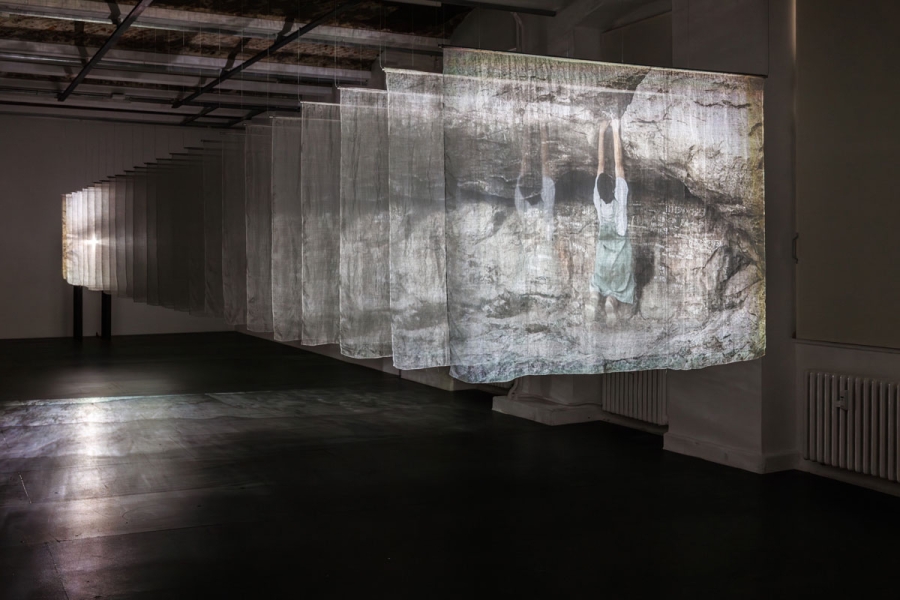
Das zweite Obergeschoss bringt mit seiner Gestaltung Licht ins Dunkel. Das Licht als Blitz der Erkenntnis – darauf verweist nicht nur das Zitat Walter Benjamins, das dem Ausstellungstext des Stockwerks vorangestellt ist, sondern es erscheint auch als aktiver Blick und Praxis des Sehens im Sinne von Sammlungs- oder Archivarbeit innerhalb der gezeigten Werke. Ebenso fragil wie der gedimmte Lichteinfall wirken die zarten Textilien, die für Saodat Ismailovas As We Fade (2024) in einer raumbestimmenden Anordnung hintereinander gestaffelt von der Decke hängen. Der auf sie projizierte Film spielt mit Motiven von Kontinuität, Wiederholung und Verschwinden und findet seinen Schauplatz in der kirgisischen Stadt Osch, die als „fragiler geografischer Knotenpunkt“ eine politische Schlüsselrolle für die Region spielt. Durch die Verbindung von Archivmaterial und zeitgenössischen Aufnahmen überkreuzen sich die Blickrichtungen von Vergangenheit und Zukunft und lassen – ganz nach Benjamin – eine neue Konstellation entstehen. Vom Gipfel des Suliman-Too, dem heiligen Berg in Osch, geht es weiter zum letzten Kapitel der Ausstellung.

Im dritten Stock angekommen, fühlt es sich momenthaft so an, als wäre nach einer langen Wanderung tatsächlich der Gipfel erreicht. Endlich fällt Sonnenlicht ungehemmt durch die Fenster des Dachgeschosses. Ein Wandel, der sich auch in der Werkauswahl niederschlägt. Der Fokus auf Film- und Installationskunst tritt zugunsten des Objekts zurück. Dieses Bekenntnis zum Haptischen – ja, zum Kleinteiligen – besitzt eine politische Dimension: Das Erinnern erscheint als etwas Persönliches und Fragiles, das sich zugleich in der Vielfalt menschlicher Erfahrungen verorten lässt und Hoffnung stiftet.
1991 (2026) von Aykan Safoğlu verbindet diese Kleinteiligkeit zunächst mit dem Ritual des Alltags indem Zeichnungen und Fotografien als Erinnerungsfragmente auf ein Puzzle gedruckt werden, das teilweise zusammengesetzt, teilweise in Einzelteilen auf dem Boden liegt. Die Fragmente stellen Verbindungen zum kindlichen Spielen ebenso wie zum archäologischen Arbeiten her und zeichnen ein Selbstbild, das so vielschichtig wie unvollkommen, so brüchig wie evolvierend ist.
A Bird That Cannot Land ist die umfangreiche und reflexive Erweiterung der sechsten Kyiv Biennial, die in Zusammenarbeit mit der Gründungsinstitution der Biennale, dem Visual Culture Research Center, entstanden ist. Ein pointiertes Begleitprogramm ergänzt die Ausstellung, die bis zum 13. September zu sehen ist. Vor allem aber gelingt ihr, was nur wenigen Ausstellungen gelingt: Sie macht Hoffnung nicht zum Gegenbild der Gewalt, sondern zu einer kontinuierlichen wie notwendigen Praxis des kollektiven und individuellen Erinnerns, Sehens und Erkennens.
Künstler*innen: Abdullah Miniawy, Adam Hanieh, Alona Karavai, Anna Ehrenstein and Yara Mekawei, Anna Zvyagintseva, Anton Kats and the Grounded Outer Space People, Assaf Gruber, Aykan Safoğlu, Azar Mahmoudian, Bulgarian Voices Berlin, Dana Kavelina, Eda Aslan, Farahnaz Sharifi, Fehras Publishing Practices, Flaka Haliti, Geta Brătescu, Gulnur Mukazhanova, Heinali and Andriana-Yaroslava Saienko, Hito Steyerl, Hiwa K, Ihor Tsymbrovsky, Ivan Krastev, Joyce Joumaa, Julia Cimafiejeva, Katarina Gryvul, Lesia Vasylchenko, Lida Abdul, Lucia Kagramanyan, Madina Tlostanova, Majd Abdel Hamid, Mona Hatoum, Nazanin Noori, Neda Saeedi, Nour Sokhon, Oleksiy Radynski, Philipp Goll, Samia Halaby, Saodat Ismailova, Sattar Stas Shärifullá and Ziliä Qansurá, Seyyare – Anatolian Women’s Choir, Stefaniia Bodnia and Jack Dove, Tjan Zaotschnaja, Tolia Astakhishvili, Ulrike Herrmann, Wafaa Saied
Kyiv Biennial
A Bird That Cannot Land
11.06.–13.09.26
Öffnungszeiten:
Mi – Mo, 11:00–19:00
KW Institute for Contemporary Art
Auguststraße 69
10117 Berlin
Website
______________
Night Walk: A Bird That Cannot Land at the KW Institute for Contemporary Art
Carla Huttenloher
On June 10, the KW Institute for Contemporary Art opened one of the chapters of the Kyiv Biennial 2025, which will continue through 2026 with exhibitions and public programs across various international venues. Titled A Bird That Cannot Land, the exhibition extends through the summer in Berlin, occupying all floors of KW.
The exploration of the various levels unfolds as a meandering narrative between war, diaspora, destruction, and external determination, but also resilience, community, and hope. The ground floor is bathed in darkness; here, the video installations appear at times monumental, at others like warm, moving lights in the night. The sky is one of the central motifs of the staging and is also reflected in the works themselves—for instance, in In Transit (2008), a video work by the Afghan performance artist Lida Abdul. The film is set on a site on the outskirts of Kabul where war has brought the sky down to earth. Like inorganic skeletons, Soviet military aircraft have created a new landscape order there, in which life carves out its own space: the work’s protagonists are a group of children who perceive the area as a site of play and imagination. The images, oscillating between violence and play, are as irreconcilable as they are striking.
The path through the hall and up the stairs resembles a night walk. The darkness continues on the first floor; once again, it is dominated by images that now become the central theme of the staging itself. As immediate tools for conveying reality as well as for disclosure, surveillance, and targeting, they are increasingly replacing language as the contemporary medium of communication. In his work Where Russia Ends (2024), filmmaker Oleksiy Radynski explores the history of settler colonialism in indigenous territories occupied by Russia. The starting point is archival material from Ukrainian filmmakers documenting expeditions through Siberia and the Far North in the 1980s. In Radynski’s film, the rediscovered footage becomes the occasion for a search for traces and the reconstruction of erased or blocked histories, as well as a critique of the documentary genre and its complicity in exploitative and oppressive systems.
The design of the second floor brings light into the darkness. Light as a flash of insight—this is suggested not only by the Walter Benjamin quote preceding the floor's exhibition text, but also appears as an active gaze and practice of seeing in the sense of collecting or archival work within the works on display. Just as fragile as the dimmed light are the delicate textiles hanging from the ceiling in a space-defining, staggered arrangement for Saodat Ismailova's As We Fade (2024). The film projected onto them plays with motifs of continuity, repetition, and disappearance, set in the Kyrgyz city of Osh, which plays a key political role for the region as a “fragile geographical junction.” Through the combination of archival material and contemporary footage, the perspectives of past and future intersect, giving rise—true to Benjamin—to a new constellation. From the summit of Sulayman-Too, the sacred mountain in Osh, the journey continues to the final chapter of the exhibition.
Arriving on the third floor, it momentarily feels as if the summit has indeed been reached after a long hike. Finally, sunlight pours unhindered through the attic windows—a transformation that is also reflected in the selection of works. The focus on film and installation art recedes in favor of the object. This commitment to the haptic—indeed, to the small-scale—possesses a political dimension: remembering appears as something personal and fragile, yet simultaneously situatable within the diversity of human experience, offering hope. 1991 (2026) by Aykan Safoğlu initially connects this small-scale approach with the ritual of everyday life, as drawings and photographs are printed as fragments of memory onto a puzzle that lies partly assembled and partly in individual pieces on the floor. The fragments establish links to childhood play as well as to archaeological work, tracing a self-image that is as multilayered as it is imperfect, as brittle as it is evolving.
A Bird That Cannot Land is the extensive and reflexive expansion of the sixth Kyiv Biennial, created in collaboration with the biennial’s founding institution, the Visual Culture Research Center. A poignant accompanying program complements the exhibition, which remains on view until September 13. Above all, however, it achieves what few exhibitions do: it renders hope not as an antithesis to violence, but as a continuous and necessary practice of collective and individual remembering, seeing, and recognizing.